

What Is Managed Detection and Response (MDR)?

Managed Detection and Response (MDR) is a cybersecurity service that combines continuous threat monitoring, advanced detection technologies, security expertise, investigation, and response to help organizations identify and contain cyber threats.

Unlike security tools that primarily generate alerts, MDR adds a human layer of security expertise. Security professionals investigate suspicious activity, determine whether a legitimate threat exists, and help coordinate or take response actions when necessary.

For small and mid-sized businesses that may not have the resources to operate an internal Security Operations Center (SOC), MDR can provide access to continuous monitoring and specialized cybersecurity expertise without requiring the organization to build and staff those capabilities internally.

  • MDR combines continuous threat monitoring, security technology, human expertise, investigation, and response into a managed cybersecurity service.
  • MDR is designed to do more than generate alerts by helping determine whether suspicious activity represents a real threat.
  • Security professionals can investigate incidents, validate threats, and help coordinate or perform response actions when needed.
  • MDR can provide 24×7 security monitoring and specialized expertise without requiring a business to build and staff its own Security Operations Center.
  • MDR is especially relevant for small and mid-sized businesses that need stronger detection and response capabilities but have limited internal security resources.

How Does Managed Detection and Response Work?

Managed Detection and Response continuously monitors security data from endpoints, identities, email, cloud environments, networks, and other supported systems for activity that may indicate a cyber threat. When suspicious activity is detected, the MDR process goes beyond simply creating an alert.

Security analysts investigate the activity, examine available evidence, and determine whether it represents normal behavior, a false positive, or a legitimate security incident. When a threat is confirmed, the MDR team can escalate the incident and help contain, remediate, and respond to the threat based on the capabilities and responsibilities defined in the MDR service.
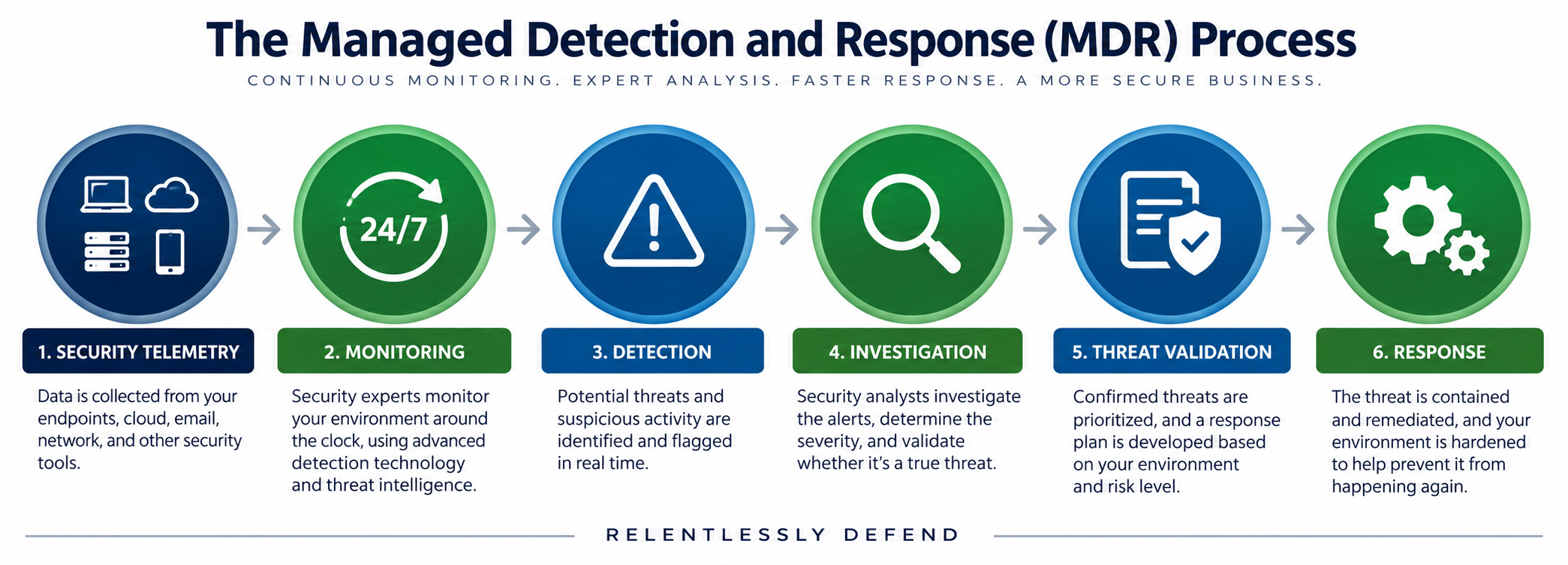
Managed Detection and Response (MDR) process from security telemetry and continuous monitoring through detection, investigation, threat validation, and response.

Continuous Monitoring and Threat Detection

Cyberattacks can occur at any time, including nights, weekends, and holidays. MDR provides continuous monitoring designed to identify suspicious activity without depending on someone inside the business to manually watch security alerts.

Detection technologies analyze security telemetry for indicators such as malicious processes, unusual account activity, suspicious authentication attempts, ransomware behavior, command-and-control communications, and other potentially harmful activity.

Investigation and Threat Validation

An alert does not necessarily mean a cyberattack is occurring. One of the important functions of MDR is determining which alerts require action.

Security analysts investigate suspicious activity and correlate available information to establish context, determine the scope of the activity, and assess its potential impact. This helps reduce the burden of sorting through large numbers of security alerts while allowing legitimate threats to receive greater attention.

What Happens When MDR Detects a Threat?

When MDR identifies and validates a threat, the response depends on the nature of the incident and the capabilities included in the MDR service. The objective is to limit the attacker’s ability to continue operating while protecting affected systems, accounts, and business data.

Containment, Response, and Remediation

Response actions may include isolating a compromised endpoint, disabling or protecting an affected account, blocking malicious activity, collecting additional evidence, escalating the incident, and providing remediation guidance.

MDR should also establish a defined escalation process so the appropriate people within the organization know when a significant security event has occurred, what actions have already been taken, and what additional steps may be required.

Organizations should also maintain a documented incident response plan that defines roles, responsibilities, communications, and actions before an incident occurs.

Important Point

MDR Is More Than Security Software

MDR should not be viewed as simply another security product. The value of MDR comes from combining security technology with continuous monitoring, human investigation, threat validation, and response. When evaluating an MDR service, businesses should understand not only what technology is being used, but also who monitors it, how threats are investigated, and what happens when a real incident is detected.

Explore the Topic

Managed Detection & Response

Learn more about how Managed Detection and Response helps businesses continuously monitor for cyber threats, investigate suspicious activity, respond to confirmed incidents, and strengthen their overall security operations.

Explore Managed Detection & Response →

Frequently Asked Questions

Find answers to common questions about Managed Detection and Response and what businesses should know.

What is Managed Detection and Response (MDR)?

Managed Detection and Response (MDR) is a cybersecurity service that combines continuous security monitoring, threat detection technology, human security expertise, investigation, and response. MDR helps businesses identify suspicious activity, determine whether it represents a legitimate threat, and respond when action is required.

Why is MDR important for businesses?

MDR helps businesses maintain continuous visibility into potential cyber threats without requiring them to build and staff their own Security Operations Center. This can be especially valuable for small and mid-sized businesses that have limited internal cybersecurity resources but still need ongoing monitoring and access to security expertise.

How does MDR help reduce business risk?

MDR helps reduce risk by identifying suspicious activity earlier, investigating security alerts, validating potential threats, and supporting timely containment and response. Faster detection and response can help limit an attacker’s ability to move through an environment, compromise additional systems, or cause further business disruption.

What should businesses look for when evaluating an MDR provider?

Businesses should evaluate whether an MDR provider offers continuous monitoring, human-led investigation, clear escalation procedures, defined response capabilities, appropriate technology integrations, useful reporting, and access to cybersecurity expertise. It is also important to understand exactly what the provider will do when a threat is confirmed and which response actions remain the customer’s responsibility.

How can Ntreks help with Managed Detection and Response?

Ntreks helps businesses evaluate and strengthen their detection and response capabilities through managed cybersecurity services. We can help assess existing security controls, identify monitoring and response gaps, implement appropriate security technologies, and provide ongoing management and guidance as part of a broader cybersecurity strategy.